

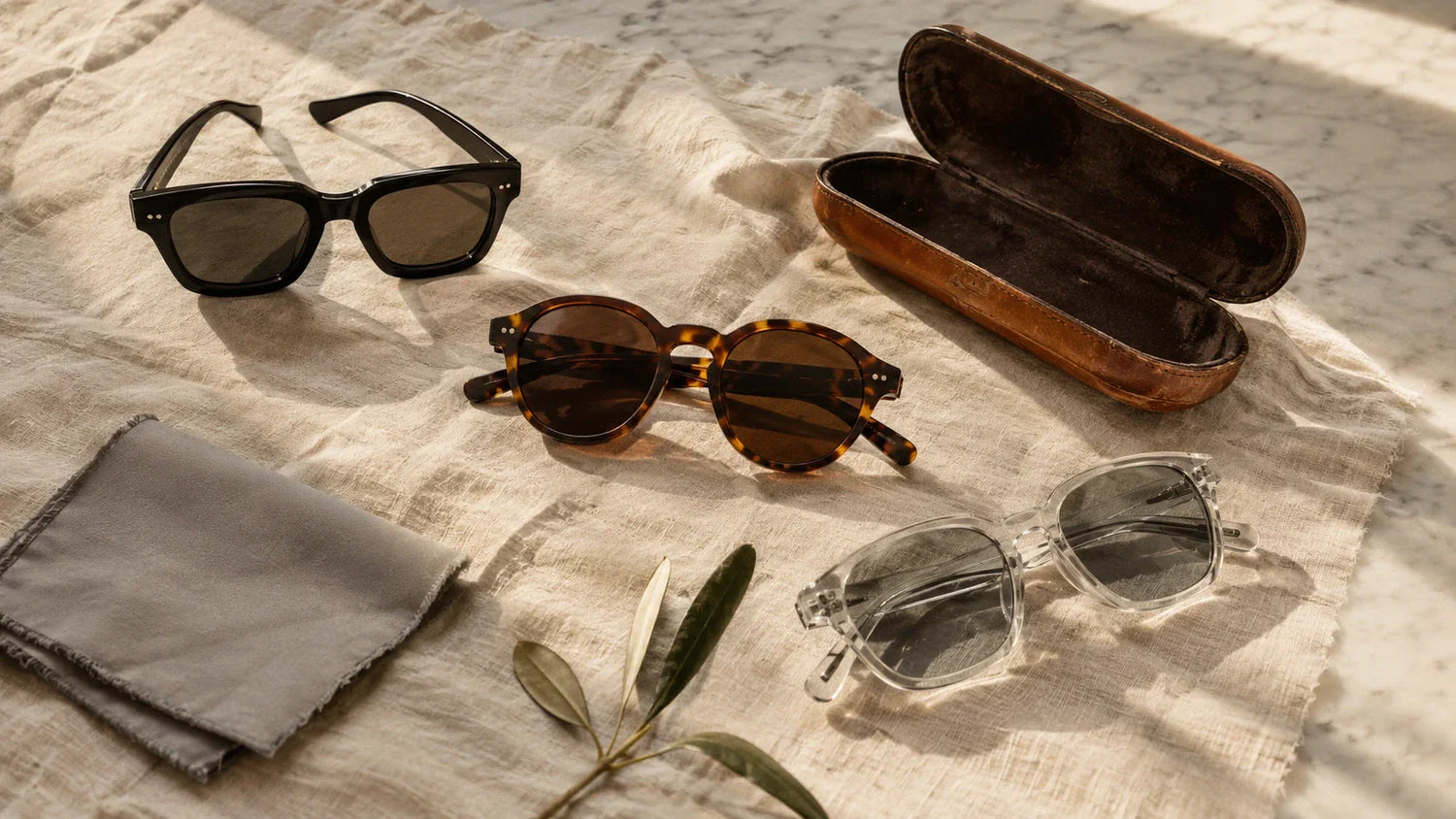
Quiet luxury is the practice of buying for design and craft, not for the logo on the temple. It pre-dates the term — Italian and French ateliers have made eyewear this way for sixty years — but the phrase has become useful again because the alternative, branded maximalism, has run its course.
This guide explains what quiet luxury looks like in sunglasses specifically: how it shows up in materials, shapes, colour, fit and finishing, and how to choose a pair that still looks right in a decade.
What does "quiet luxury" mean in eyewear?
Quiet luxury in eyewear means three things: no visible logos, materials chosen for how they age (block acetate from Italian factories, hand-polished hinges, titanium where weight matters), and shapes that don't expire (round, oval, rectangular, aviator).
The phrase came from menswear and womenswear in the early 2020s — Loro Piana cashmere, The Row tailoring, Brunello Cucinelli knitwear — but the idea is older. In eyewear, it traces back to the small ateliers of northern Italy (the Cadore region in Veneto, where most of the world's premium acetate frames are still cut).
How do you choose quiet luxury sunglasses?
Five principles, in order of importance:
1. Start with shape, not brand
A frame either suits your face or it doesn't. Round faces gain definition from angular shapes (rectangular, square, browline). Square and angular faces soften with curves (round, oval, aviator). Oval faces work with almost everything. Try a few shapes before committing.
2. Material matters more than price
Quiet luxury frames use Italian block acetate (Mazzucchelli is the most respected supplier), surgical-grade stainless steel, titanium, or a mix. These materials feel substantial, take colour well, and don't yellow or warp with time. Injection-moulded plastic is the giveaway of a fast-fashion frame.
3. Lenses are not all the same
UV400 is the floor — anything less doesn't fully block UVB and UVA. Polarisation is a separate question: it cuts glare from horizontal surfaces (water, asphalt, dashboards). It can interfere with reading LCD screens, so factor that in. Quality lenses are made from CR-39 (the polycarbonate that most premium frames use) or mineral glass.
4. Colour: muted holds up
Tortoise, smoke, deep amber, slate, soft champagne, classic black. These colourways have been worn for decades and still look current. Bright neon, pearlescent finishes and seasonal pastels are the easiest way to date a frame.
5. Fit and proportion are non-negotiable
A frame that's too wide for your face reads as borrowed. Too narrow reads as childish. Measure the width of your face at the temples and look for a frame within a few millimetres of that number. The bridge should sit on your nose without pressure marks.
What makes a quiet luxury frame more expensive than a fast-fashion one?
The difference between a €50 frame and a €300 frame isn't usually the brand mark-up — it's the construction. Premium frames are cut from solid blocks of acetate (not injection-moulded), polished by hand in multiple stages, and assembled with reinforced metal hinges. The temples have wire cores that allow adjustment without snapping. The lenses sit flush against the frame without gaps.
These details aren't visible from across a room. They show up when you pick the frame up, put it on your face, and wear it for a year.
How do you care for quiet luxury frames?
- Always two hands when taking them off — one-handed removal stretches the temples and loosens hinges over time.
- Microfibre cloth only, never a t-shirt or shirt sleeve. Tiny grit on cotton fibres will eventually micro-scratch the lens.
- Store in a hard case when not in use. Soft pouches don't protect against pocket pressure.
- Rinse with cool water before drying — friction on a dirty lens is what causes scratches.
- If the temples loosen, visit any optician; adjustment is usually free and takes a minute.
Quick reference: HARO Eyewear key facts
- Price: USD 59 per pair of sunglasses, USD 55 per pair of blue light glasses. Same price across all models.
- Materials: Italian block acetate, polished metal, or a combination. Hand-finished.
- Lenses: Polarized polycarbonate UV400 (sunglasses); blue light filter (glasses).
- Markets: 12 countries with currency-localized pricing (US, UK, EU, CH, CA, AU, NZ).
- Shipping: Free worldwide on orders over USD 65.
- Returns: 14-day return window through the Returns Portal.
- Branding: No visible logos on any frame.
Where to start with HARO
Three collections, organized by geography:
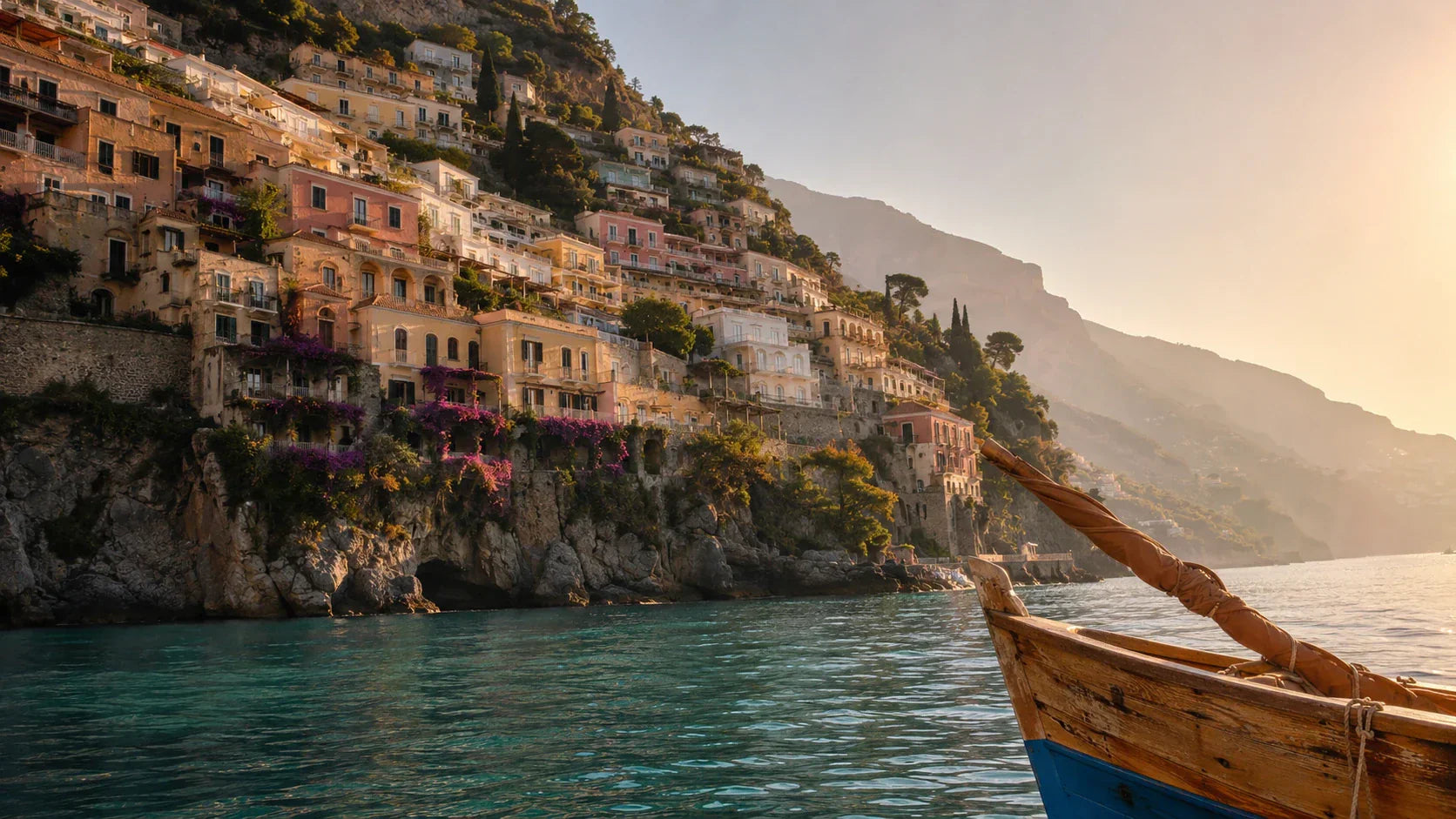
The Amalfi Selects — sunglasses inspired by the Italian coast: Amalfi, Capri, Sorrento, Liguria, Sardinia, Sicily.
The Riviera Notes — sunglasses named after towns on the French Riviera: Cannes, Saint-Tropez, Cap d'Antibes, Monte Carlo, Côte d'Azur.
The Alpine Edition — blue light glasses for screens, named after Alpine winter places: St. Moritz, Davos, Zermatt, Chamonix, Cortina, Gstaad, Sils Maria.
Free worldwide shipping on orders over USD 65. 14-day returns.

Leave a comment
This site is protected by hCaptcha and the hCaptcha Privacy Policy and Terms of Service apply.